
Training
GLF Active members participate in a number of courses yearly that develop and maintain important skills that are required, not only on a fire scene, but on medical assist calls for BC Ambulance Service, as well as a number of other tasks. These skills are “perishable” and must be refreshed periodically.
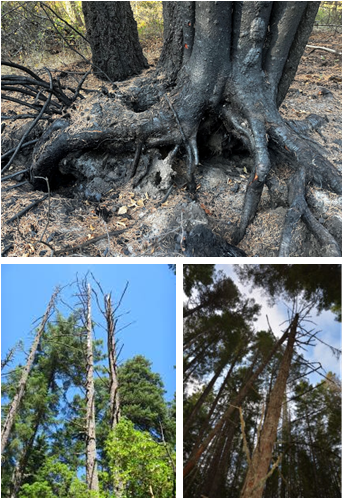
Danger Tree Course
This online orientation course is intended for workers who work around dangerous trees in forestry operations - harvesting, silviculture and firefighting.
Upon completion of this course, participants will be able to understand:
What a danger tree is and why its important.
What happens on worksites to identify and control danger trees.
Basic danger tree characteristics and what to look for.
How to keep yourself (and others) safe.
Click here to start course:
S-100 & S-185 Courses
S-100
The most common fire training course in B.C. is the S-100, which is considered as basic fire suppression training. The S-100 and S-100A are required to meet the training requirements under Section 26.3.1 Forestry Operation Fire Fighting of B.C.’s Occupational Health and Safety Regulation.
The S-100 is a two-day, 16-hour course with both classroom and field components. The annual refresher is an online course. Both the S-100 and S-100A are good for one year from date of delivery. If a person has taken either course within the last five years, they would only need to take the S-100A to be considered trained for the following year. If more than five years have passed since a person has taken either course, they would need to re-take the two-day, S-100 course again.
S-185
The S-185 is a general knowledge course on wildfire safety and entrapment avoidance.
Photos: Randy Perazzo

WSPP-115 - Structure Protection Course
Participants learn sprinkler application and other structure protection techniques utilizing FireSmart principles.
Prerequisite: S-100 (Basic Fire Suppression and Safety) and S-185 (Fire Entrapment Avoidance)
Installation and application of sprinklers on structures using wildfire pumps and hose and fire service hose and hydrants. This technique creates a humidity bubble over the structure and dampens flammable materials around the structure.
Safe work practices in the Wildland Urban Interface.
Equipment and personal items required for deployment.
Triage of structures and completion of required paperwork.
Overview of equipment inventory in Type 1 and Type 2 Structure Protection Units (SPU).
FireSmart principles for structure protection.
Portable pump operation and troubleshooting.
Hose lays and sprinkler selection and placement.
Tactical response before, during, and after fire impingement.
How to deliver an effective crew briefing.
Pre-learning student manual is provided before course delivery
16 hours in person over two days
Combination of practical exercises and theory
Training is led by qualified BCWS instructors
Photos: Randy Perazzo


Crew Leader Course
Prerequisite: S100 & S185
A composite course that provides certification in:
(ICS-100) Incident Command Structure Level 100
S-212 Fireline Communications
S-232 Portable Pumps & Water Delivery Systems
S-230 Single Resource Crew Leader
(ICS) Incident Command Level 100
Classroom training with evaluation criteria by a written exam. Upon completion of this course, students will demonstrate a basic knowledge of:
List the five major organizational activities within the Incident Command System and explain their primary functions.
Give the titles, and explain the duties of Command and General Staff members.
Match organizational units to appropriate Operations, Planning, Logistics, or Finance Sections.
Match supervisory titles with appropriate levels within the organization.
Describe the terms used to name major incident facilities, and state the function of each.
Describe what an Incident Action Plan is and how it is used at an incident.
Describe how span of control functions within the incident organization and in the use of resources.
Describe the common responsibilities (general instructions) associated with incident or event assignments.
Describe several applications for the use of ICS.

S-230 Single Resource Leader
4-5 hour classroom training with evaluation criteria by a written exam. Upon completion of this course, students will demonstrate a basic knowledge of Single Resource Leader procedures including:
Understand the ICS structure and where the SRL fits
Know how to properly supervise your crew
How to set an example in safety practices
How to maintain the safety and welfare of the crew
Motivate the crew towards good productivity
Maintain crew discipline in a firm and fair manner
Maintain good communications with all supervisory personnel
Photos: Al Leighton

S212 Fireline Communications
2-3 hour classroom training with evaluation criteria by a written exam. Upon completion of this course, students will demonstrate a basic knowledge of radio communications and equipment used in the BCWS and the roles, authorities and regulations.
Industry Canada: Regulations and Safety
Rules and regulations
Emergency communications
Techniques and Procedures
BC Wildfire Service Radio System
BCWS Repeaters and Tones
How to use a radio
S232 - Portable Pumps & Water Delivery Systems
Classroom training with evaluation criteria by a written exam. Upon completion of this course, students will demonstrate a basic knowledge of:
Hydraulic Forces
Pumping Terminology
Pumping Equations
Pumps
Hose
Water Delivery
Tanks and Tankers
Fire Extinguishing Agents

Rope Rescue Course (2 Day)
Prepares volunteers to perform rope rescue operations in wildland situations:
core principles
roles and responsibilities
planning consideration
site assessment
equipment considerations
Photos: Al Leighton


Chainsaw Safety Course (1 Day) & (2 Day)
Work environment/surroundings
Personal Protective Equipment
Parts & Maintenance of the chainsaw
Safe work procedures & safe cutting techniques
Morning: classroom
Afternoon: fieldwork, bucking hazards, discussion of binds and practice with cuts.
Photo: Carmen Stacey

OFA Transport Endorsement
Prerequisite: Occupational First Aid Level 1 or Occupational First Aid Level 2.
8 hour program focusing specifically on the transport of injured workers to medical aid.
Patient packaging for transport include supine and lateral positioning for trauma, ¾ prone drainage and position of comfort Review of patient assessment to an OFA Level 1 standard Review of critical airway, breathing and circulatory intervention with C-Spine management
Photos: Randy Perazzo & Norris Girling

